How RealSavvy does it
Where listings come fromYour MLS, through an approved feed
Where they showOn your own domain
What you get backBuyer activity in Follow Up Boss
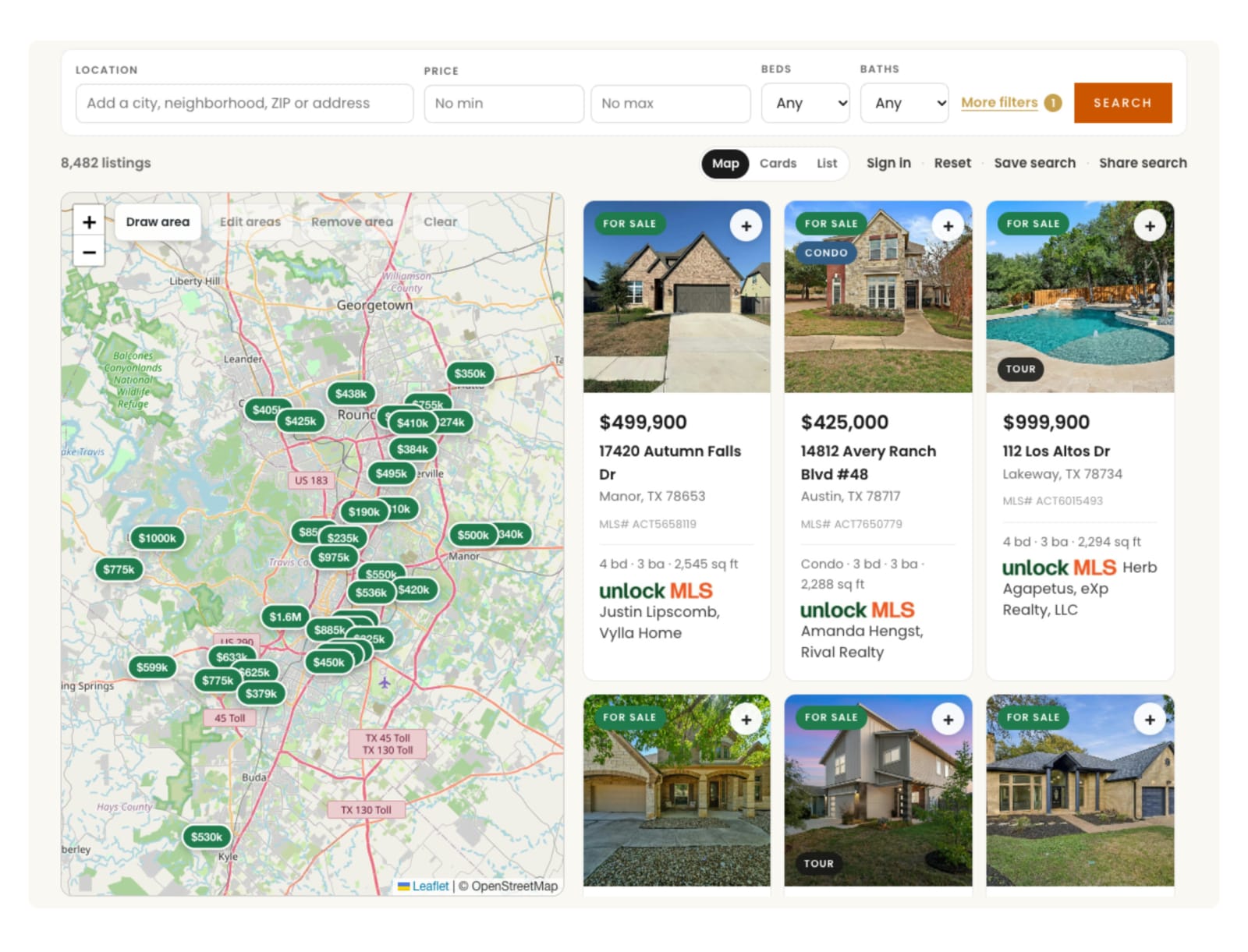
RealSavvy MLS search widget
The MLS search widget, live on a test page.

Questions

What people also ask

How does IDX work?

IDX (Internet Data Exchange) works by feeding listings from the MLS (Multiple Listing Service) (the private database agents share) out to public websites under license. The MLS authorizes a member, defines what data and display rules apply, and sends a regularly updated feed of consumer-safe listing fields. The website's IDX software ingests that feed and shows the listings to visitors, refreshing on a set schedule. The result is that buyers browse near-current MLS inventory on an agent's site without the agent manually entering a single listing. IDX is essentially the licensed bridge between the agents-only MLS and the public web.

What does IDX stand for?

IDX stands for Internet Data Exchange. It refers to the policy-and-feed framework that lets MLS (Multiple Listing Service) members display each other's listings on their own websites. In real estate, IDX has nothing to do with medical coding or stock-market indexes; it specifically means the authorized exchange of MLS listing data to the internet. When an agent says their site "has IDX," they mean it's connected to an MLS feed and can show active listings from across the market, not just their own, under the MLS's display rules.

How often does IDX data update?

IDX data typically updates on a recurring schedule set between the MLS and the feed provider, commonly ranging from every few minutes to a few times a day depending on the MLS. The MLS pushes or makes available the latest changes (new listings, price reductions, status changes, sold properties) and the website ingests them on that cadence. This is why an agent's IDX site can lag the raw MLS slightly but still stay far more current than many third-party portals. The exact frequency varies by MLS, so refresh intervals differ from market to market.

What is the difference between IDX and MLS?

The MLS is the source database; IDX is how its listings reach public websites. The MLS (Multiple Listing Service) is the private, membership-only system where agents enter and share listings. IDX (Internet Data Exchange) is the licensed program and data feed that authorizes members to publish those listings online for consumers. You can't access the MLS without a license, but you see MLS data every time you browse an IDX-powered site. In short: the MLS holds the data, and IDX distributes an approved, consumer-facing slice of it to the web.

Do I need an IDX feed for my real estate website?

Yes, you need an IDX (Internet Data Exchange) feed if you want your real estate website to display active MLS listings beyond your own. Without IDX, your site can only show your personal listings and static content, which gives buyers little reason to stay or return. With an IDX feed, visitors search the full local market on your domain, and you capture that search behavior as leads. As of 2026, RealSavvy provides IDX as a widget on an existing site from $99/mo (plus a $99 one-time setup) or as a full website with native IDX from $199/mo (plus $250 setup); the first MLS feed is included and additional feeds are $50/mo, month-to-month with no contract.

How do I get an IDX feed for my MLS?

You get an IDX feed by being a licensed member of your local MLS in good standing, then requesting IDX authorization for the website provider you choose. The MLS reviews the request, approves the feed under its display rules, and provisions access for your provider to connect. Most providers handle the technical setup once you sign the MLS's IDX paperwork. Because each MLS has its own application and rules, the process varies by market. RealSavvy supports this across 300+ MLS feeds, with your first MLS feed included and additional feeds $50/mo, as of 2026.

Why do IDX listings sometimes look like they're on another website?

IDX listings can look like they're on another website when a provider embeds the feed in an iframe. A window that loads pages hosted on the provider's separate domain rather than your own. Visitors notice the URL change or a different layout, and crucially, search engines and AI tools often credit that external domain instead of your site. The alternative is native rendering, where listings become real pages on your own domain. RealSavvy uses native rendering with no iframes, so each listing is an indexable page that builds your site's authority rather than a third party's.

Can IDX listings be found on Google and by AI tools?

IDX listings can be found on Google and by AI tools only when they're rendered as real, crawlable pages, not when they're trapped in an iframe pointing to another domain. Iframed listings are hard for search engines to attribute to your site and harder still for AI answer engines to cite. Native IDX, where each listing is its own indexable page on your domain, is what makes those pages eligible to rank and be quoted. RealSavvy renders IDX natively across 300+ MLS feeds for this reason, which is also the foundation its AEO plans build on.

Does IDX show every listing in my market?

IDX shows nearly every active listing in your market, because it draws from the MLS (Multiple Listing Service) that captures the large majority of for-sale inventory in a given region. The main gaps are listings that never go on the MLS. Some owner-sold (FSBO) homes, certain builder-direct new construction, and the occasional off-MLS arrangement, plus any listings whose brokers opt out of IDX display. For practical purposes, an IDX feed gives buyers a near-complete view of the local market on an agent's own site, sourced directly from the most authoritative database available.

How much does an IDX website cost?

As of 2026, an IDX website's cost depends on the setup: RealSavvy offers an IDX widget on an existing site for $99/mo plus a $99 one-time setup, or a full website with native IDX for $199/mo plus a $250 setup, with team and broker plans from $299/mo. Your first MLS feed is included and additional feeds are $50/mo. All plans are month-to-month with no contract. Pricing across the industry varies, but the key variables are always whether you get a full site or just a widget, and how many MLS feeds you need.

Ready when you are.

Pick what you need and see your exact price in two minutes, then sign and pay online. Want to look around first? Click through the real product, no sign-up needed.