How RealSavvy does it
| Built on | Savvy Studio |
| Search | Native, styled to the brand |
| Price | Website + IDX $199/mo plus a $250 setup |
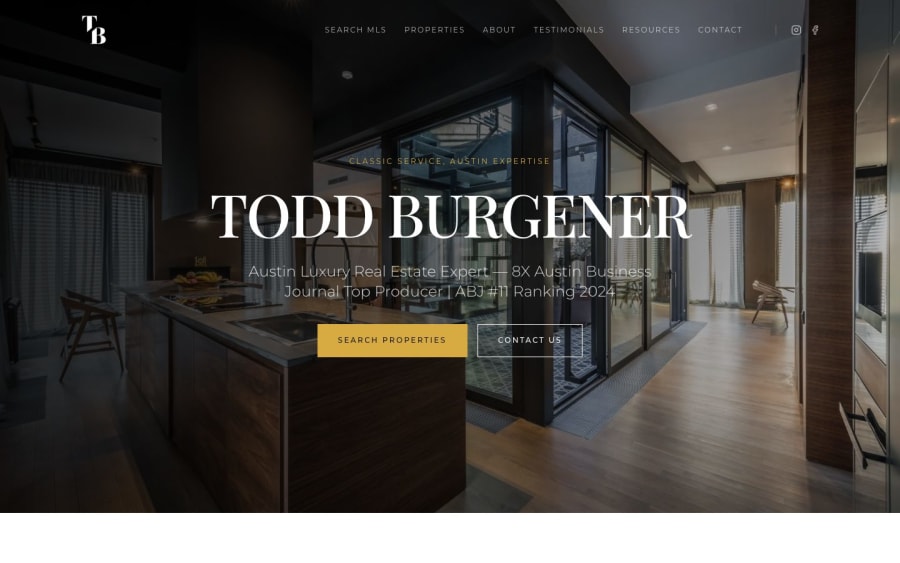
Real Estate Websites
Large photography, restrained type, fast pages and search that looks like the brand instead of a vendor's widget. RealSavvy luxury sites are built on Savvy Studio with native MLS search on your own domain.
| Built on | Savvy Studio |
| Search | Native, styled to the brand |
| Price | Website + IDX $199/mo plus a $250 setup |
Questions
The register, not the architecture. Luxury design leads with imagery. Full-bleed photography, cinematic property video, white space, quiet typography, because the inventory justifies it and the audience expects it. Underneath, the requirements are identical to any producing real estate site: a working MLS search, listing pages at real URLs, capture tied to buyer behavior, CRM delivery. Luxury sites earn the right to be quieter on the surface; they do not earn an exemption from the plumbing.
Restraint executed expensively. Large-format photography and video shot for each property rather than pulled from MLS; a serif or high-contrast typeface used sparingly; muted palettes that defer to the imagery; navigation that recedes; and property storytelling (the estate's history, the architect, the land) alongside the spec sheet. The discipline is subtraction: every badge, popup, and widget removed raises perceived value. Clutter reads as mass-market faster than any other signal.
Yes, and skipping it is the genre's most expensive mistake. Affluent buyers search inventory like everyone else. They simply expect the experience to be better. A luxury site without IDX (Internet Data Exchange. Live MLS listings on your own domain) is a portfolio, and portfolios send active buyers back to Zillow. The luxury treatment of IDX is curation: lead with your own listings and a refined default filter, but keep the full search available. RealSavvy renders it natively, in your design system, from 300+ MLS feeds.
As stories with a spec sheet, not spec sheets with photos. The strong pattern: a full-screen opening image or film, a short written narrative about what the property is (the architect, the land, the light) then the gallery, then facts and floor plans, then a discreet inquiry path. Discretion matters in both directions: price-on-request handling, private showings language, and capture that asks little (name and contact) while offering much (the full film, the floor plans, early access to similar listings).
Trade access, not attention. The capture moments that fit the register: register to view the full film or floor plans, request the off-portal details, save the search for similar properties, book a private showing. Each offers something a serious buyer values and asks only for contact in return. No popups, no countdown banners, no chat widgets bouncing for attention. The follow-up side matters equally: captured leads should land in your CRM with their viewing behavior attached, so outreach reads as informed rather than automated.
More than almost any other segment. Luxury buyers and their advisors ask AI assistants exactly the questions a luxury site should own, who sells in this enclave, what is the market for waterfront in this town, and the engines answer by citing sites they can read: real URLs, structured data, answer-first content. A visually stunning site built as one long script-rendered film is invisible to that conversation. As of 2026, the luxury sites winning AI citations pair the cinematic layer with a readable, schema-marked page structure underneath.
Pick what you need and see your exact price in two minutes, then sign and pay online. Want to look around first? Click through the real product, no sign-up needed.

Our AI CRM, IDX inside Follow Up Boss, and luxury websites for agents, teams and brokerages. Month to month, live in days.
Contact
Products
Who it's for
© 2026 AGNT AI, Inc. RealSavvy is a product of AGNT AI, Inc.